Noticias y actualidad

The most commonly failed questions on the motorcycle licence test
In order to identify the five questions most commonly answered incorrectly in practice tests for the motorcycle licence theory test (A1 and A2), 100,000 tests taken between April and June were analysed.
First, we will review which vehicles can be driven with A1 and A2 licences. Next, we will look at a selection of the five most commonly failed questions, together with the reasons behind these mistakes. Finally, we will provide the key points to help you answer them correctly.
Which vehicles can we drive with A1 and A2 licences?
Anyone with an A1 licence can ride motorcycles with a maximum engine capacity of 125 cm3, a maximum power output of 11 kW and a maximum power-to-weight ratio of 0.1 kW/kg.
By contrast, the A2 licence allows you to ride motorcycles with a maximum power output of 35 kW and a maximum power-to-weight ratio of 0.2 kW/kg, provided they are not derived from a vehicle with more than twice that power. In addition, obtaining this licence also grants the A1 licence.
Which questions are most commonly answered incorrectly?
1. When riding a motorcycle, do you consider it necessary to wear gloves?
Possible answers:
- A) No, because they make the motorcycle more difficult to control.
- B) No, except in winter.
- C) Yes, because in the event of an accident, they effectively protect the rider. (Correct answer)
Explanation: Gloves should be worn to protect your hands, even in summer. Their use is recommended because they provide a better grip on the motorcycle controls and, in the event of a fall, help reduce possible friction burns.
The key to this question: Wearing gloves is not widespread among motorcyclists. Many consider them secondary and do not give them the importance they actually have for rider safety.
2. If you are riding your motorcycle and fall at 25 kilometres per hour without wearing a protective helmet, could you suffer a head injury?
Possible answers:
- A) Yes, but only a minor injury, given the low speed at which the impact may occur.
- B) Yes, skull injuries, but not brain injuries.
- C) Yes, both skull and brain injuries, which can be very serious. (Correct answer)
Explanation: A helmet reduces the severity of head injuries and is also compulsory for both the rider and passenger on all types of roads when travelling by motorcycle.
The key to this question: On short journeys or in urban areas, many motorcyclists do not wear a protective helmet. This is a serious mistake because an impact without a helmet at an apparently low speed, such as 25 km/h, puts the human skull at the limit of its protective capacity.
3. When riding a motorcycle, what safety distance should you leave between yourself and the motorcycle in front if you do not intend to overtake it?
Possible answers:
- A) Enough distance to allow me to stop without colliding with it if it brakes suddenly. (Correct answer)
- B) Twice the distance I should leave behind a car.
- C) The distance that provides better aerodynamics.
Explanation: When riding a motorcycle behind another vehicle, the rider must leave enough space between the two vehicles to be able to stop without colliding with it in the event of sudden braking. In addition, if the rider has not signalled an intention to overtake, the distance maintained must allow a vehicle following behind to overtake safely. This latter requirement does not apply:
– In built-up areas.
– Where overtaking is prohibited.
– Where there is more than one lane in the same direction.
– When traffic is so congested that overtaking is not possible.
The key to this question: It is common to see drivers failing to maintain a safe distance both inside and outside built-up areas. This is a serious mistake and causes many accidents because the driver may not have enough time to react and stop the vehicle when necessary.
4. This sign prohibits…
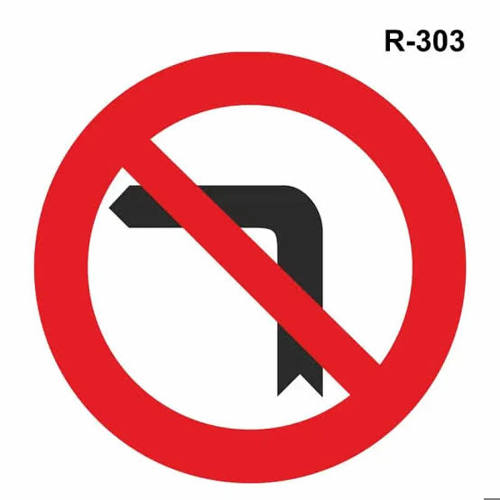
Possible answers:
- A) Turning right only.
- B) Turning left only.
- C) Turning left and making a U-turn. (Correct answer)
Explanation: This is the R-303 sign, which prohibits turning left. It also prohibits making a U-turn.
The key to this question: When you see this sign, it is clear that turning left is prohibited, but it may not be obvious that making a U-turn is also prohibited. This question is often answered incorrectly because both restrictions are not taken into account. Whenever you see this sign, remember the number “2”, because it prohibits two things: turning left and making a U-turn.
5. When riding your motorcycle on a road outside a built-up area with two lanes travelling in the same direction, are you allowed to overtake a car travelling in front of you at 90 km/h?
Possible answers:
- A) No. (Correct answer)
- B) Yes, provided that you do not exceed 110 km/h when overtaking.
- C) Yes, but only if I do not enter the left-hand side of the carriageway.
Explanation: On conventional roads, the general maximum speed is 90 km/h for cars and motorcycles. These vehicles may exceed the speed limit by 20 km/h to overtake other vehicles travelling below the road's maximum speed. If the maximum speed is restricted by signs, it may not be exceeded when overtaking, unless the posted limit is the same as the general maximum speed for that road.
The key to this question: “There are still drivers and future drivers who consider speed limits to be too low, without being aware that speed not only increases the number of accidents but also increases their severity”.
In short, road signs continue to cause the most problems for learners due to their wide variety and the specific details that need to be known about each one, together with questions relating to road safety.
Source: La Vanguardia
Book your ITV appointment and pay online to avoid having to go through the office.